Nam June Paik – The art of a connected world

Our life is half natural and half technological. Half-and-half is good. You cannot deny that high-tech is progress. We need it for jobs. Yet if you make only high-tech, you make war. So we must have a strong human element to keep modesty and natural life. 

– Nam June Paik
IMG_3467

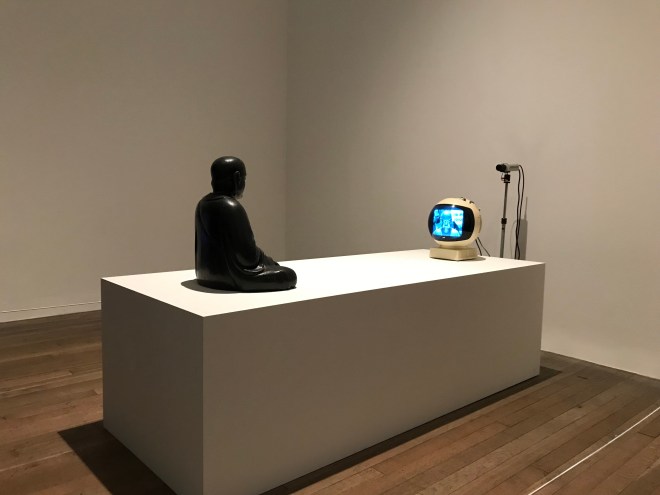
As I entered the first room of this exhibition I immediately felt that this exhibition had a very different atmosphere compared to others I have been to. The electrical buzzing sound, the flashing colours and the Buddha statue sitting in front of a TV watching himself all made it very clear right at the start that Nam June Paik (1931-2006) was not an artist who followed the mainstream.

The South Korean artist, who lived and worked in Japan, Germany and the United States mainly focused on cultural differences, traditions of both Eastern and Western cultures, especially through the lens of our increasingly connected world. The exhibition at Tate Modern showcases the artist’s work through five decades.

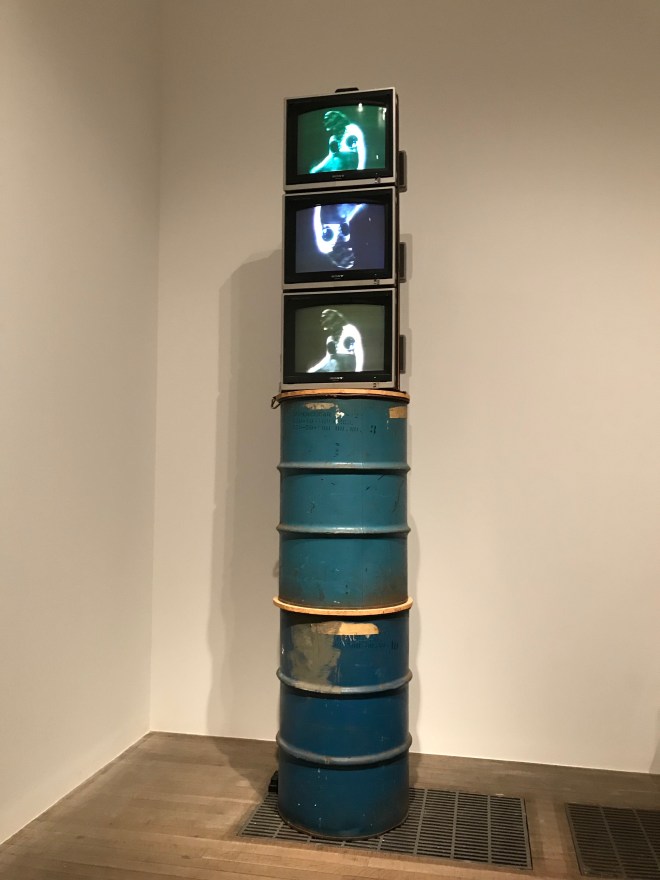
One of my favourite work regarding the use of sound and vision was the ‘Oil Drums’. Paik made this work as a memorial to Charlotte Moorman following her death in 1991. The ‘topless cellist’ worked together with Paik for almost thirty years. They shared a common interest in avant-garde music and staging energetic live performances and believed that sexuality was unjustly excluded from classical music.

The exhibition piece is two metal barrels that were used during Moorman’s performances of Variations on a Theme by Saint-Saens. Moorman suddenly stopped in the middle of the performance, climbed a ladder and submerged herself in the drum on top, which was filled with water. After the dip, she climbed back out and finished playing the sentimental tune while dripping wet.

Placing the three TVs on top of the two barrels makes the observer feel like they are watching the whole performance in real-time. The echoes of the drum and the water blurred the border of reality in my head as I watched the screen. Looking at the screen from below also made me feel like I was right there while Moorman performed. With this piece Paik was playing with the idea of borders, the literal border of the surface of the water, inside and outside and also on an abstract level, the idea of past and present, existence and non-existence, life and the afterlife.

Turning the television in the middle upside down was also interesting. As Moorman submerged herself in the water she was getting closer to herself on the screen on top, but simultaneously moving away from herself in the bottom screen.
IMG_3570
Oil Drums, Hommage a Charlotte Moorman 1964,1991 (Click to view)

Num June Paik’s significant role in finding the bridge between art and technology is unquestionable. He was exploring the border between the two and experimenting with the TV and the screen. He used the screen as a canvas like nobody before him. The Korean American artist’s work is at Tate Modern, London, until 9 February 2020.
The future on our plate

IMG_3814
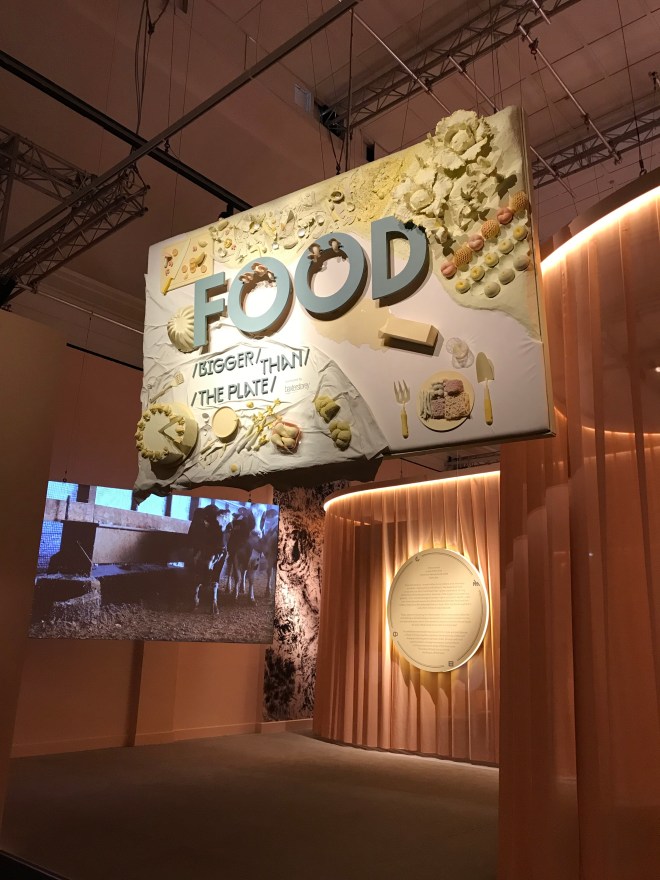
Entrance of the exhibition

Food – it relates to everyone, yet the largest global issues that need solving today – from the changing climate to the right of workers and public health services – can all be traced back to what we eat and how we eat. In this situation the currently existing food system which mostly took shape in the industrial revolution needs to be reconsidered. As the distance between the source of our food and our plates grow we all feel disconnected from what we eat. Often we don’t know where it comes from and how it was made.

The exhibition at the V&A ‘FOOD: Bigger than the plate’ shows the reality of our food production, explores questions and possibilities for a better food future. They displayed designers’ and artists’ works through four areas, starting with composting, then farming, trading and eating.


The exhibition had a very strong start, exploring our relationship with waste, what is disposable and what could be reused. An unexpected aspect of this was human waste. In past centuries it has returned to the earth, but now it’s getting flushed down the toilet along with some drinking water to a landfill or the ocean. This is ruining the nutrient cycle.

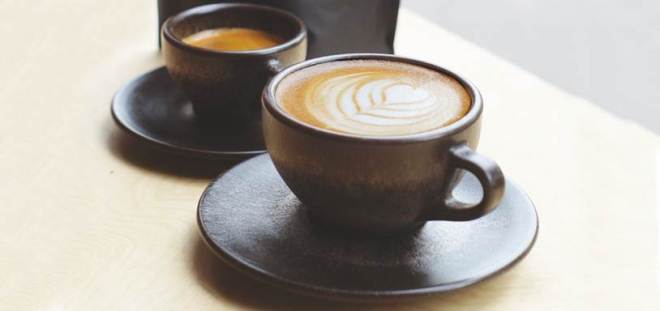
One of my favorite items displayed was the Kaffeeform cup, designed by Julian Lecher. These coffee cups are made out of used coffee grounds, gathered from cafes around Berlin, closing the ‘loop of the cycle.’ I really loved the idea that we can make waste presented in a beautiful and practical way in day to day life instead of just throwing it away.


kaffeform
Jennifer Ferreira​(​2018) Kaffeeform coffee cups b​y Julian Lecher

With the industrial revolution, farming methods and people’s diet has changed. Most people are detached from how food gets to the supermarkets, how animals and other species are involved and how we depend on them to survive.

To boost our food production humans always tried to redesign plants and animals to suit their needs with techniques like selective breeding which was essentially a pioneering method similar to modern genetic engineering. However now meat is mass produced and has become cheap and a central part of this new industrialized system.

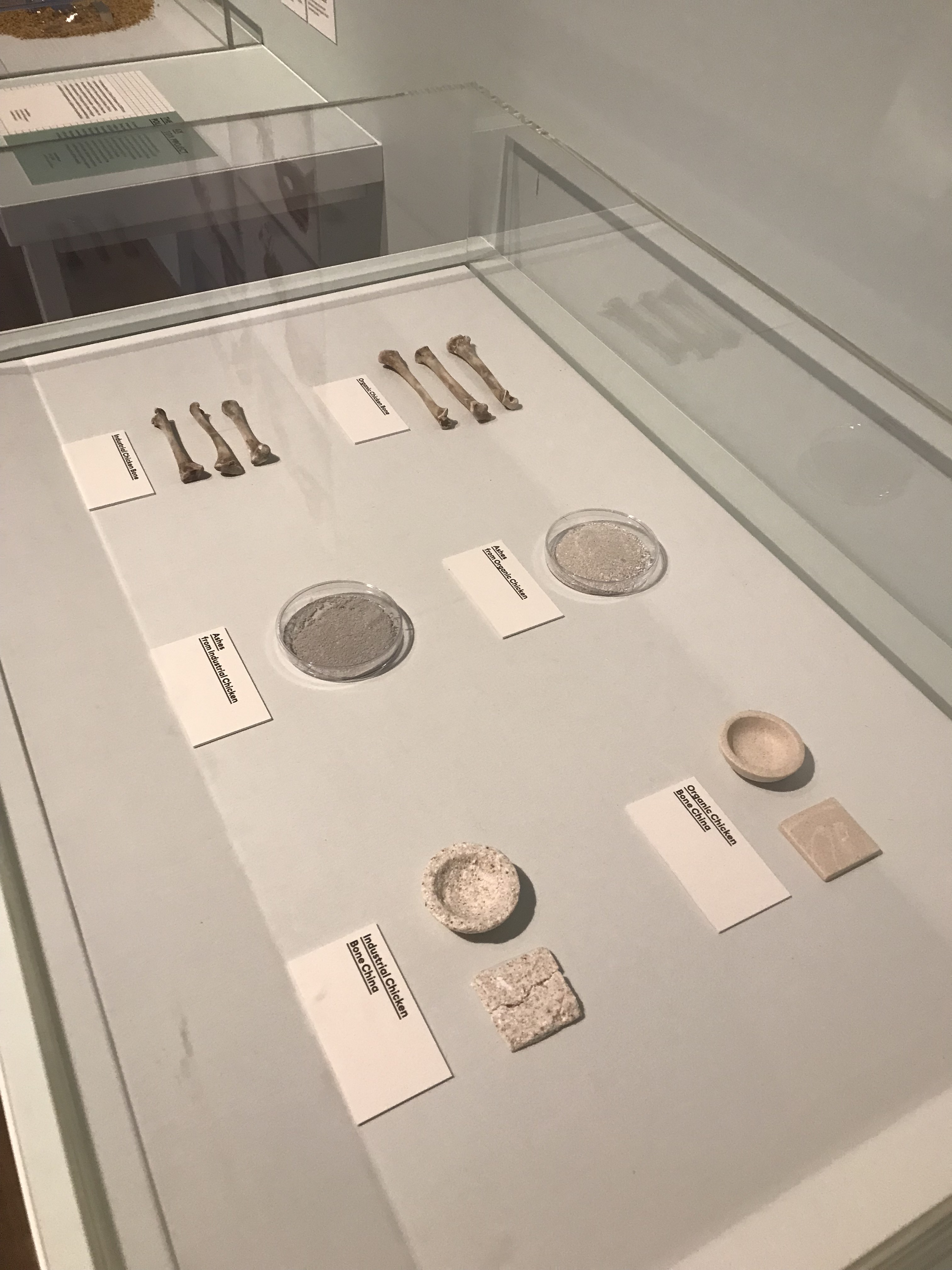
After I watched a 13 minute clip from the documentary ‘Our daily bread’ that presented our European high-tech food production. I entered the next room where they displayed ​​Nienke Hoogvliet’s work. She worked with scientists to make porcelain from the bones of factory farmed chickens and organically raised chicken, the difference between the two was obvious.

IMG_4085.JPG
Bare Bones by Nienke Hoogvliet

The food we consumed used to be from local farms, livestock and plants and we ate different food in different seasons. Industrial production may have lowered the price of food in our supermarkets’ shelves but the true cost of this has only been shifted behind our back. The way in which we relate to what we eat is more visual, focusing on brands and not on the act of eating itself.

The last part of the exhibition, eating, presented bold new ideas around cooking and eating, it experimented with rules and traditions to prepare us for what we might have on our plates in the future.

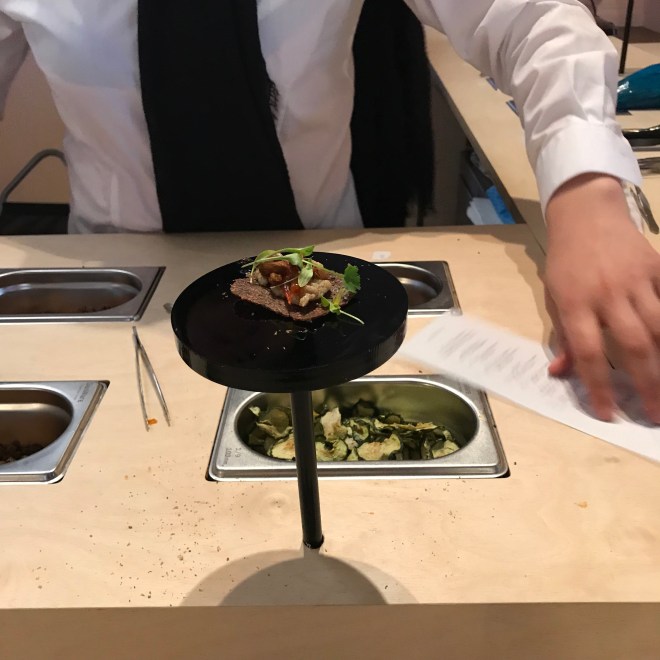
At the end of the exhibition we were asked by LOCI Food Lab if we could design a better food culture, what would our top priorities be? We were given 16 choices (such as from zero waste, biodiversity, affordability to transparency, etc.) and were allowed to choose three. Then based on our choices we were given a chance to taste our own food and were served a personalized snack, drawn from a selection of ingredients from the english lowlands beech forest bioregion (in which the V&A is located).

IMG_4381
LOCI Food Lab

It was a great finish to this exhibition. Although at some point during the exhibition I felt that there is no way back, we messed it up too much, I left with a feeling of hope and motivation. Better food future is different for everyone. Our priorities are different. What is sure that over the last 150 years our society has made lots of mistakes and we have to start having a new discussion when we look to the future.

For the few big corporations controlling the food industry the most important thing is profit. In pursuit of this they are willing to neglect nutrition, taste, fairness and diversity. But thankfully the number of people who don’t agree with this is growing and they are constantly challenging our reality. They try to make the process of how food is delivered to our plate more visible, while also trying to make trade and distribution better. The value of food is being refocused from profit to benefiting everybody from those who produce it to the people who eat it and ultimately: the planet.

The future starts here – exhibition review

solar shirt
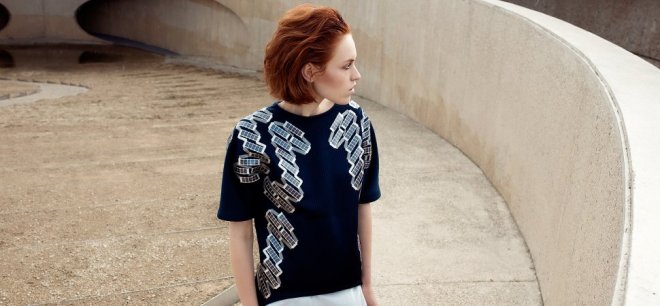
Solar Shirt by Pauline van Dongen

Some of us would give anything to know what will happen in the future. Others are more afraid to even think about it. I was very excited on my way to the V&A’s exhibition to find out how the exhibition explores what is shaping the world of tomorrow.

‘Every new invention, technology or design idea of the present shapes our future’. This was the main idea that formed the whole exhibition. They displayed more than 100 contemporary products or projects, all of them showing how the future might look. The objects are either newly released or in development, but all real. Displayed across four zones – self, public, planet and afterlife – they do not determine our future, but suggest a certain future.

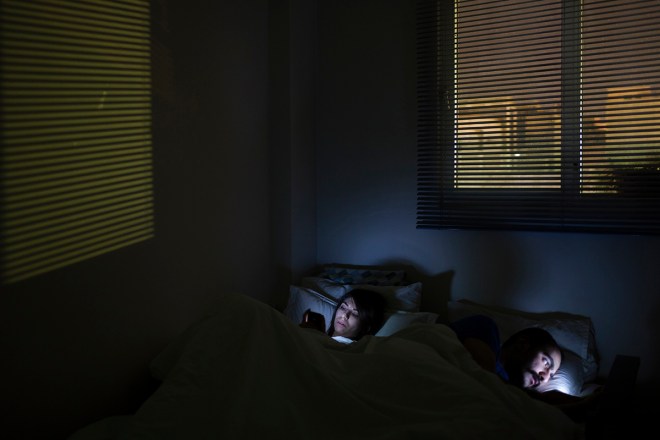
Among many items, they displayed a solar shirt, ‘a shirt that powers your day’ which can generate enough electricity in one hour to charge a smartphone. ‘A smartphone that never leaves our side’. Which became an extension of our body. Which we use to browse, navigate, listen to music, order food. Which can easily connect us to our friends and family regardless of the distance. Why do we feel lonely then? I found the photographs by Hanif Shoaei very disturbing as it was just so relevant and real.

0486d0bf-5026-4788-87e8-765c1c2a6802
Technology in Bed by Hanif Shoaei

The furry robotic seal that NHS use with dementia patients to comfort and care was probably one of the most surreal item I have ever seen. It really made me think about how we are living in a disconnected society. How we have shifted our priorities and putting ‘ME’ in the first place. We expect more and more from our machines to make our lives easier. Are these machines really making our lives easier? Or will we forget how to care for each other? With these questions in my mind I entered to a mini version of ‘the restaurant for one’ called Eenmaal designed by Marina van Goor. The restaurant only features tables for one. It is designed to break the social standard to eat with someone in public.

In a digital age, online platforms give individuals the opportunity to organise, join and create new communities. The exhibition questions whether the future will be defined by top-down governmental systems, or if it will be shaped by citizen-led organisations. We all want to be independent. We all want to be in control. But are we really in control? Cambridge Analytica (CA) uses data analysis to monitor and influence political elections. CA played a huge role in the US presidential race, helping Donald Trump’s victory. Uber drivers are ‘independent contractors’, but the company uses an algorithm to connect certain drivers with passengers, which removes all sense of independence. Everybody wants to be their own boss. But what if your boss is an algorithm?

Unfortunately our digital traces are also often misused by massive online corporations, like Google, Apple, Microsoft, Facebook. The size of the Sainsbury Gallery made it possible to hang an object like Facebook’s Aquila drone, which is currently in development to enhance internet connectivity in places around the world where internet connection is still not provided. High above everything, this 40-metre width drone looked very scary actually. A giant bird that is harvesting personal information. Are we going to live in the shadow of these giant corporations in the future I wonder?

So what will the future look like? Curators gave visitors the opportunity to come to our own conclusions with an interactive game at the end. As I left the building I tried to remember myself of the note which was written on the wall at the beginning. ‘The future we get is up to us, because the future starts here.’

Photographs:

Shoaei, H. (2014) Technology in Bed

Fleur, L. (2015) Solar Shirt by Pauline van Dongen