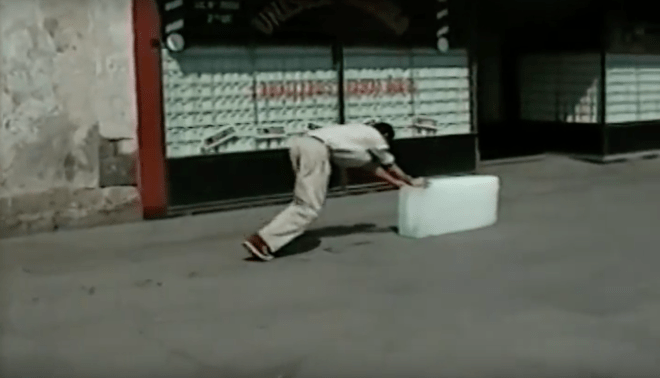
As we watched the video of Francis Alÿs pushing a block of ice through the streets of Mexico City I could’t help myself to think about the things in my life that will disappear. Disappear the same way this mark behind the ice block itself disappeared in the heat of the sun in just seconds. This action of the artist took more than nine hours until the block has melted, all in the name of “sometimes making something leads to nothing”.
For someone who is living a very fast paced lifestyle, this nine hour act which was condensed into a 10 minute short video was painful to watch. I desperately tried to find the most rational reason for this action. Still can’t quite believe that I am saying this but I came to the conclusion that it all makes sense because it has been recorded. It made me question how much I am living in the virtual world or on social media or other online platforms. If something is not documented is it losing from its importance? Was it worth it if you can’t see the result? I can’t see it so its not there?
I would be very interested to know what Francis’ thoughts were during this performance, is the title “sometimes making something leads to nothing” was something that he decided before or after the experiment?
We all leave traces behind ourselves. Some of them are visible, some not, but it doesn’t make it less important if you can’t see the result and sometimes it is very important to let ourselves live without the pressure of visible achievements.
At the end of the session we were talking about how a line is just as important as the outer space that it leaves behind because everything is in relation to each other. So in my opinion nothing can lead to nothing if everything is connected.
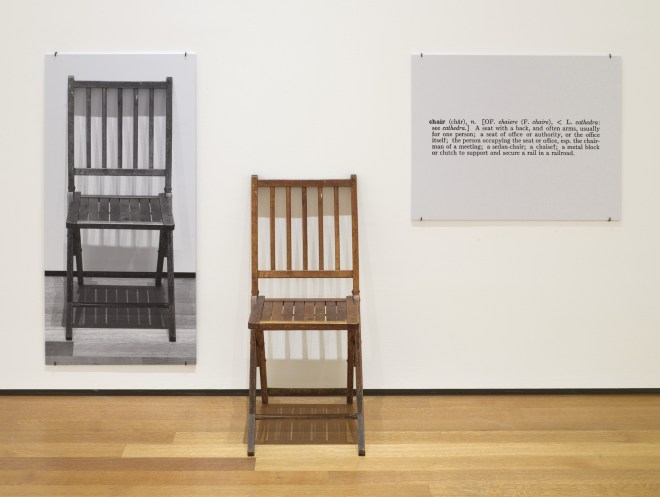
In relation to lines we also talked about surfaces and traces. One of the examples we were shown was the work of Joseph Kosuth: ‘one and three chairs’. He represented a chair in three different ways next to each other: the actual chair, a size accurate photograph of the same object, and the definition for the word ‘chair’.
I think this installation of Kosuth is very provocative in a good sense. If I want to be honest it did not make me go wow in the first moment. But it provoked questions in me such as ‘what is art?’ ‘Is it really art?’ The more I was thinking about what Kosuth’s message is behind this work the more I started to appreciate it. I started exploring the relation between these forms of the chair. If I say chair, would it mean the same for everyone? How can I be sure that the chair on the photograph is exactly the one that is on display? Is it real if I can’t touch it? Is it real if it is only described verbally? Does it mean the same for everyone? My first impression turned into quite an admiration, the concept of looking at things using different platforms and exploring their meaning that way is very interesting. It made me realize that everything depends on your point of view.

